
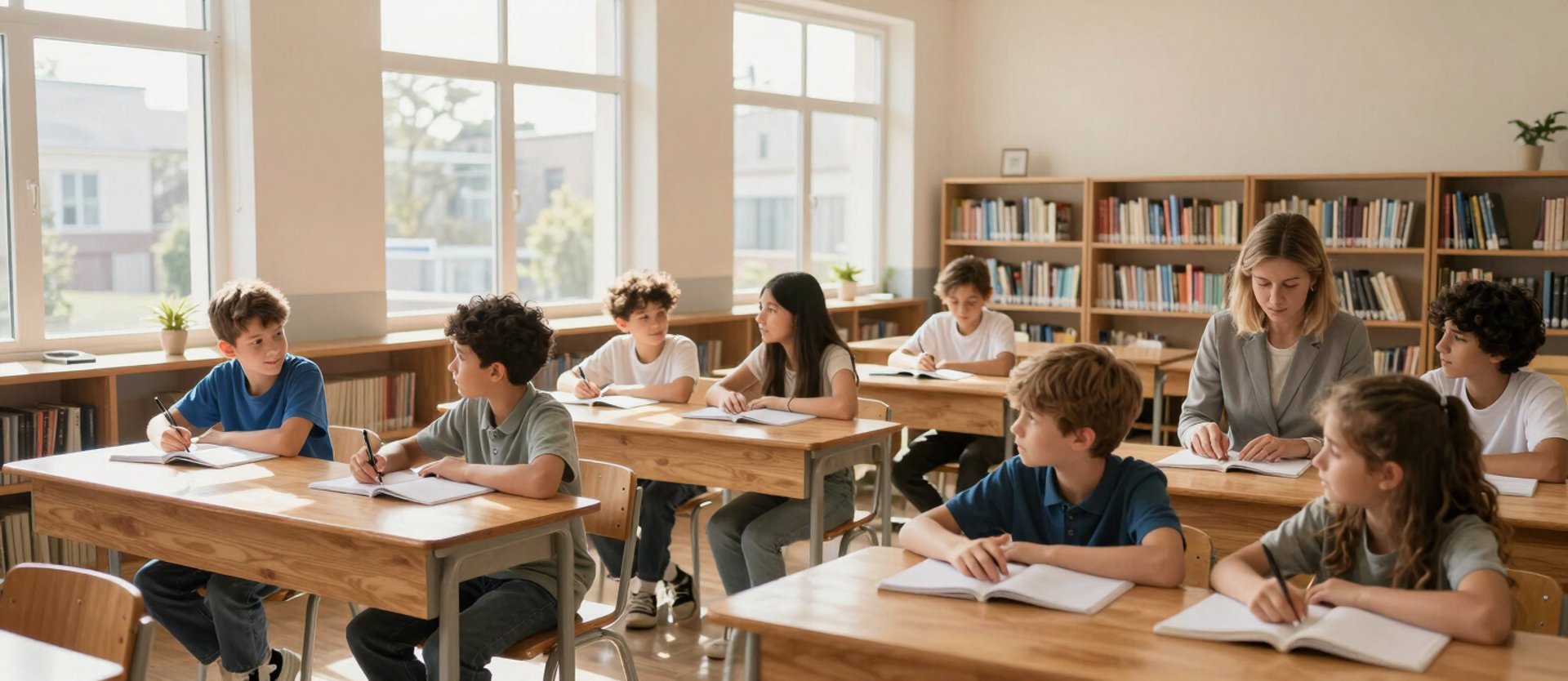
Every subject taught as if it matters — because it does.
Math, literacy, science, arts, and movement share equal space in our schedule. No subject is a filler; each one builds a different kind of thinking.
Six disciplines, one balanced schedule.
Reasoning over rote recall
Reading closely, writing clearly
Questions before answers
From number sense in kindergarten to pre-algebra in grade 8, students learn to reason through problems, not just execute procedures.
Students read across genres and write in multiple modes — narrative, expository, argumentative — building a toolkit they use in every other subject.
Lab work and structured inquiry begin in grade 1. Students form hypotheses, test them, and revise — a habit of mind, not just a unit.
Context builds civic thinking
Expression as a core skill
Movement as part of the day
Local community, US history, and world geography are sequenced so each year's content builds on the last, culminating in analytical civics by grade 8.
Drawing, music, and drama are taught weekly — not as extras but as disciplines with their own vocabulary, feedback loops, and standards.
Structured PE and daily outdoor time are scheduled — not squeezed in. Physical activity is a cognitive support, and we plan accordingly.
Building the foundation years
Subject specialization, balanced schedule intact
Middle school students move to subject-specific teachers for math, science, language arts, and social studies — without dropping arts or PE from their weekly schedule.
Primary years establish reading fluency, number sense, and scientific curiosity through a structured daily rhythm. Teachers track progress across academic benchmarks and dispositions — how engaged, how persistent, how curious.
Grades 6–8 introduce independent research projects, cross-subject writing, and structured peer critique — skills that carry students confidently into high school.
Class sizes stay small — no more than 22 students — so each child's learning pace is visible to their teacher every day, not just at report time.


The full day is the curriculum.
A student's day includes structured academics, creative work, and unstructured outdoor time. That sequence is deliberate — not a scheduling accident.
After-school clubs in robotics, debate, and ensemble music extend the day for families who want it — none are required, all are staffed by teachers who chose to be there.